

April 16, 2026
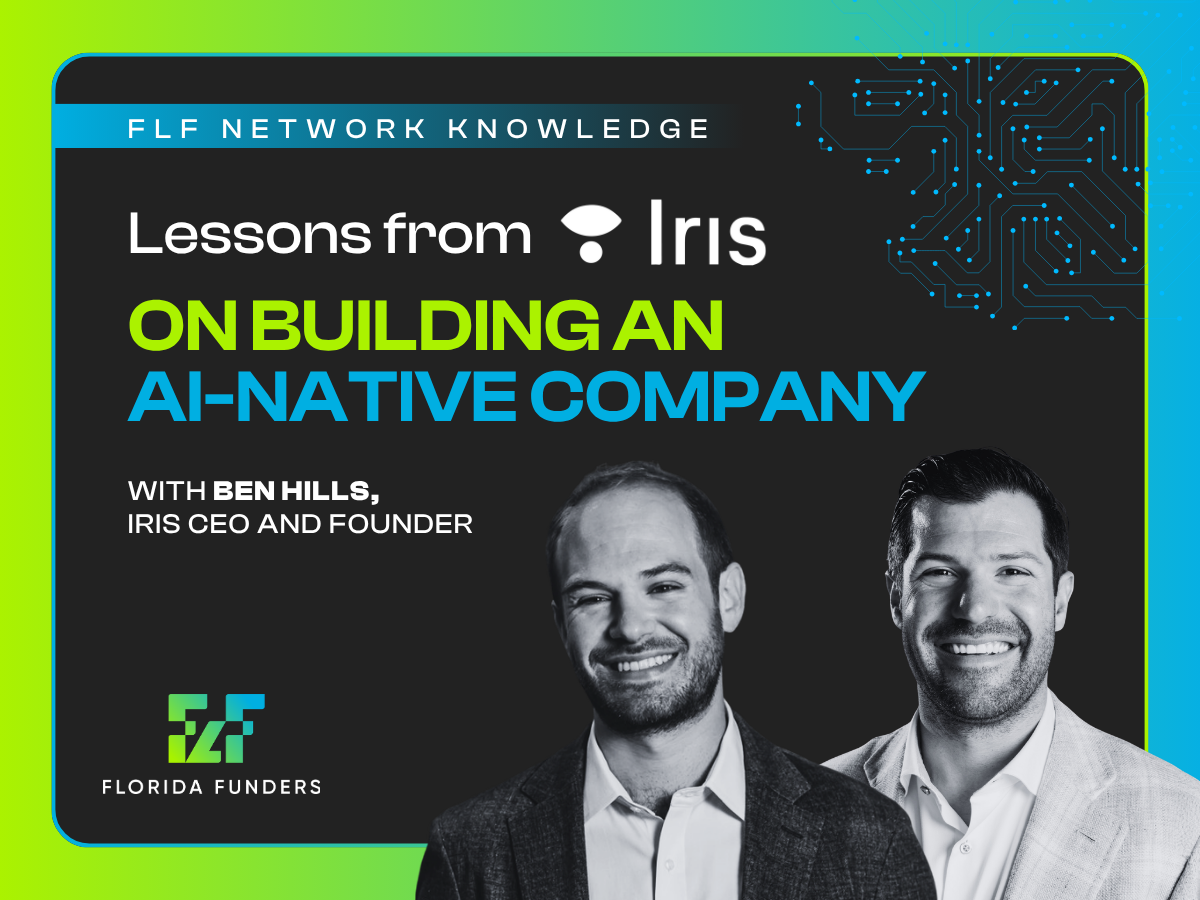
FLF Network Knowledge: Lessons from Iris on Building an AI-Native Company
AI-native is a phrase a lot of companies use. Our Fund 3 portfolio company, Iris AI, is one of the few that can show you what it means in practice.
As part of FLF's commitment to an ecosystem where founders actively learn from each other, Ben Hills, Iris’ CEO and founder, recently sat down with Saxon Baum to open up his team's AI playbook and share his real-world learnings with founders across our portfolio and network.
The mindset shift that has to happen first
Most CEOs declare AI a priority and hand the work to someone else. That kills the initiative before it starts. Culture follows the CEO's behavior, and if the CEO is still doing Google searches while telling everyone else to be AI-native, the team knows it.
The behavior that moves a team is seeing the CEO use AI in the actual work of running the business, like meetings, goal-setting, updates, and hiring. For anyone who feels behind, open Claude, tell it your job and your company, and ask how it can help. People who can clearly articulate what they're trying to accomplish get the most out of these tools.
Appointing an "AI czar" and waiting for that person to drive adoption only concentrates the initiative in one place instead of distributing it across the team, which is where the real output gains come from.
On the ground: How to build an AI-native culture
Standardization and shared content are the two things that consistently separate companies that get traction with AI from those that stall.
Giving everyone an AI budget and letting them use whatever they want trades short-term flexibility for long-term fragmentation. The best value comes from accumulated context. When a whole team works inside one platform, knowledge builds on itself. Ben's customer success team writes release notes in Claude; his marketing team pulls from those to build content; engineering can see which features are gaining traction. That compounding only happens within shared tools.
Making this stick requires a work culture in which AI use is visible, shared, and celebrated across every level. Ben runs an internal channel where team members share new use cases, publicly recognize standout usage, and track a leaderboard of token consumption across the team to signal that heavy usage is worth celebrating.
Hiring reinforces it. Every Iris candidate has a take-home exercise they must complete using AI, and they have to show the prompts they used. The candidate who produces sharp work within a tight turnaround time and walks through their reasoning showing confidence and eloquence in their AI use is the one Iris wants.
Tactical examples founders can steal
Conference prospecting
Before any conference, Iris runs an app that takes the exhibitor link, cross-references it against their HubSpot CRM, flags current customers and active deals, researches every other company in the hall, and produces a prioritized prospect list with cold outreach drafted for each target. All before anyone boards a plane.
Sales cycle compression
Before a first sales call, Iris runs a "compound skill" in Claude that scrapes the prospect's documentation and knowledge base, builds a fake RFP in that company's voice, and populates a live Iris instance with their information. The prospect arrives at the first call looking at the product configured around their own content, and deals that previously took multiple calls and a trial period are now closing in 30 minutes.
The follow-up works the same way. A Claude skill pulls the call transcript, HubSpot data, and web research, then builds a deck specific to that company with their stated concerns and an implementation roadmap, plus a two-minute audio version of the proposal. One prospect asked for a generic case study to share with their CFO, but Ben sent the personalized package instead. The deal closed two weeks faster.
Goal-setting
Before their 2026 offsite, Ben fed Claude hundreds of call transcripts, their win/loss history, and every feature shipped in 2025. Claude produced a detailed retrospective. Ben then built an app that collected anonymous input from every employee on the biggest blockers to hitting their goals and synthesized it into an operating model for the year. The team arrived at the kickoff seeing their own thinking reflected in the company's goals, which is buy-in that's hard to manufacture through a top-down planning process.
The app now runs their ongoing OKR process automatically. Owners get a Slack notification every Friday at 4pm, responses aggregate, and the summary feeds into Monday's leadership meeting.
The questions tech founders should be asking right now
Here are three questions worth sitting with:
- Does your team have a shared stack, or is everyone using something different? If it's the latter, that's the first thing worth changing.
- Are you using AI yourself in the core work of running your business, or delegating it? The companies getting the most out of these tools are the ones where the CEO's fingerprints are on the outputs.
- Where in your business are people translating information between teams? That's typically where AI compounds fastest, replacing the handoff with shared context everyone can pull from directly.
Putting it into practice
The tactical examples above are replicable. The harder work is getting an organization to actually change how it operates. There will be pushback, but the only way to build a genuinely AI-native operation is to get to the other side of that resistance, and it’s well worth the effort.
FLF invests in founders, and that means more than capital. Putting real operational knowledge like these AI lessons in front of early-stage companies is one of the most tangible ways we live that out.
If you’re an FLF portfolio company founder and want deeper insights into maximizing AI across your operations, reach out so we can direct you to our private videos of Ben’s webinar, or with other AI-first founders within our network.
If you’re a founder in our broader tech ecosystem check out these top knowledge grabs (clip 1 + clip 2) and keep building. You got this.
For investors, the quality of support a VC provides its portfolio matters as much as the deals it sources. The companies in our network aren't figuring this out alone. If you’re ready to invest in bleeding-edge, AI-native tech startups, join our Investor Network as an accredited investor.
Updated On
